Fit mechanics
One neck measurement, three different shirt sizes. Here is what actually decides the fit.
State & Liberty publishes a chart built on six body measurements. Read it closely and you can see why off the rack shirts fail a trained torso.
There is a moment in a fitting room that one particular kind of man knows by heart. The collar closes. The shoulders sit where they are supposed to sit. Then he turns to the side and finds a handful of shirt hanging off the small of his back, gathered like a curtain, waiting to be tucked into something and hidden.
He already knows both of his options. Buy for the neck and pay someone to take in everything below it. Buy for the waist and give up the top button. Neither of those is a fit. They are two ways of choosing which half of the shirt is allowed to be wrong.
What is interesting is that the reason is not hidden anywhere. It is printed on the size chart, in public, and it takes about ninety seconds to see.
Part oneThe two numbers a dress shirt is sold on are both limb measurements
A dress shirt has traditionally been ordered on a neck and a sleeve. Both of those describe a limb. Neither of them describes the distance around your chest, and nothing in that pair describes the difference between your chest and your waist, which is the single number that decides whether a shirt hangs straight or bells out at the back.
That omission is only a problem when the numbers stop moving together. Training is exactly what makes them stop. The chest and the back get wider, the waist does not follow, and the label loses the ability to describe the body it is being asked to cover.
The clearest way to see it is to plot a real chart. State & Liberty publishes one, and unlike a conventional shirt chart it does not stop at two numbers. It asks for six: neck, sleeve, height, weight, chest and waist. The first row alone explains why.
I tried every store in the world looking for a dress shirt that I could button at my size 18 neck (occasionally I have to wear a necktie) that didn’t leave the rest of my torso and arms swimming in yards of excess fabric. Apparently clothing manufacturers think if your neck is that big you must be the size of an NFL lineman or rugby prop.
Matt G., 5 ft 11, 190 to 210 lb, bought XL, normally wears large. Published review, June 3, 2026.
Read the neck row on its own, as in the chart at the top of this page, and the ranges overlap heavily. A neck between 17.5 and 18 inches sits inside three sizes at once: large, extra large and double extra large. The sleeve row is worse. A sleeve between 35 and 36 inches sits inside four of them, because large runs from 33 to 36 inches and extra large, double and triple all run from 35 to 37.
So the two numbers a dress shirt has always been sold on can narrow an athletic torso down to a choice of three, and then they are finished. Something else has to make the call.
Part twoPlot the chest row and the overlap disappears
That is the whole tell. On this chart the chest is the index and the neck is a detail. Extra small covers 34 to 36 inches, small 36 to 38, medium 38 to 40, large 40 to 42, extra large 42 to 44, double extra large 44 to 46, triple 46 to 50. Seven windows, no overlap, one answer per body.
Which means the honest instruction for a man with a trained upper body is not the one he has been following for twenty years. Stop leading with the collar. Measure around the fullest part of the chest, under the arms, and read that number first.
Part threeWhat a pattern does with the gap between the two
Knowing your chest is half of it. The other half is what the shirt does with the distance between that number and your waist, and this is where a pattern is either drafted for the shape or it is not.
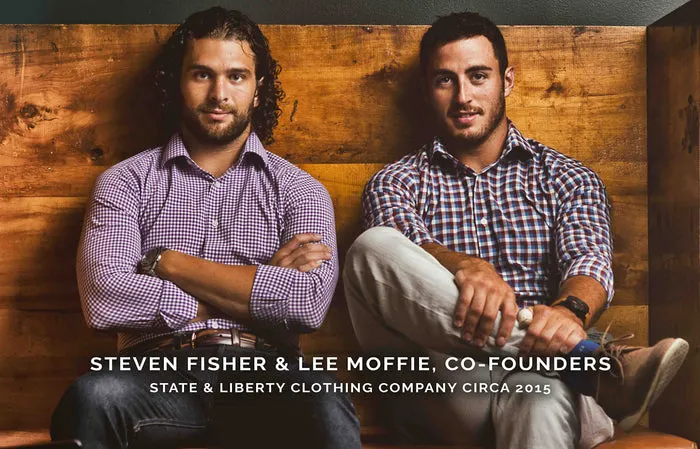
State & Liberty describes the problem in its own founding note, which is unusually blunt for a clothing brand. Off the rack shirts, it says, are made for the masses. Slim fit shirts are too tight through the athletic upper body. Standard fit shirts are too boxy at the waist. The company was started, in its own words, because the founders could not find a dress shirt that fit their build and were tired of paying for custom shirts and tailoring.
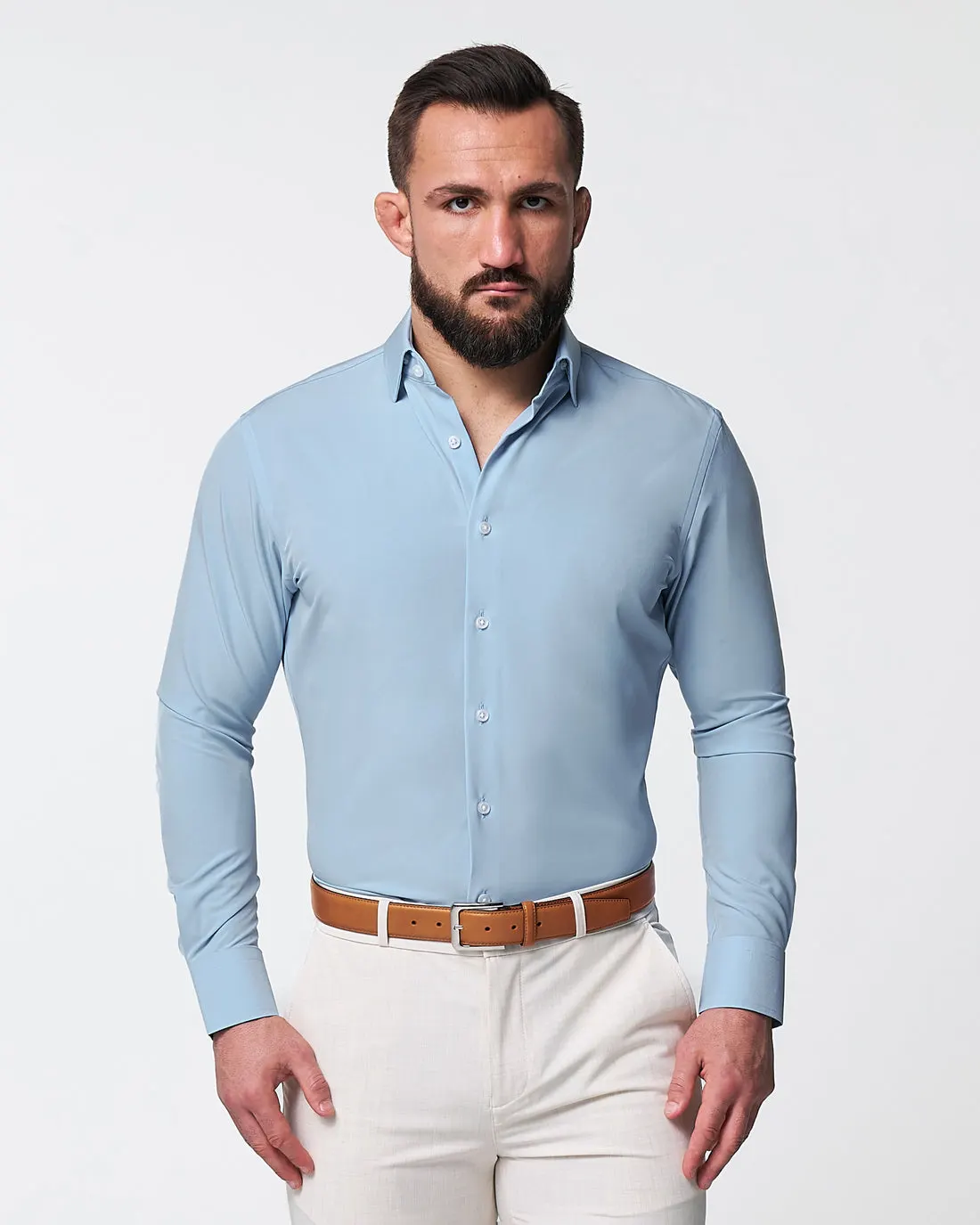
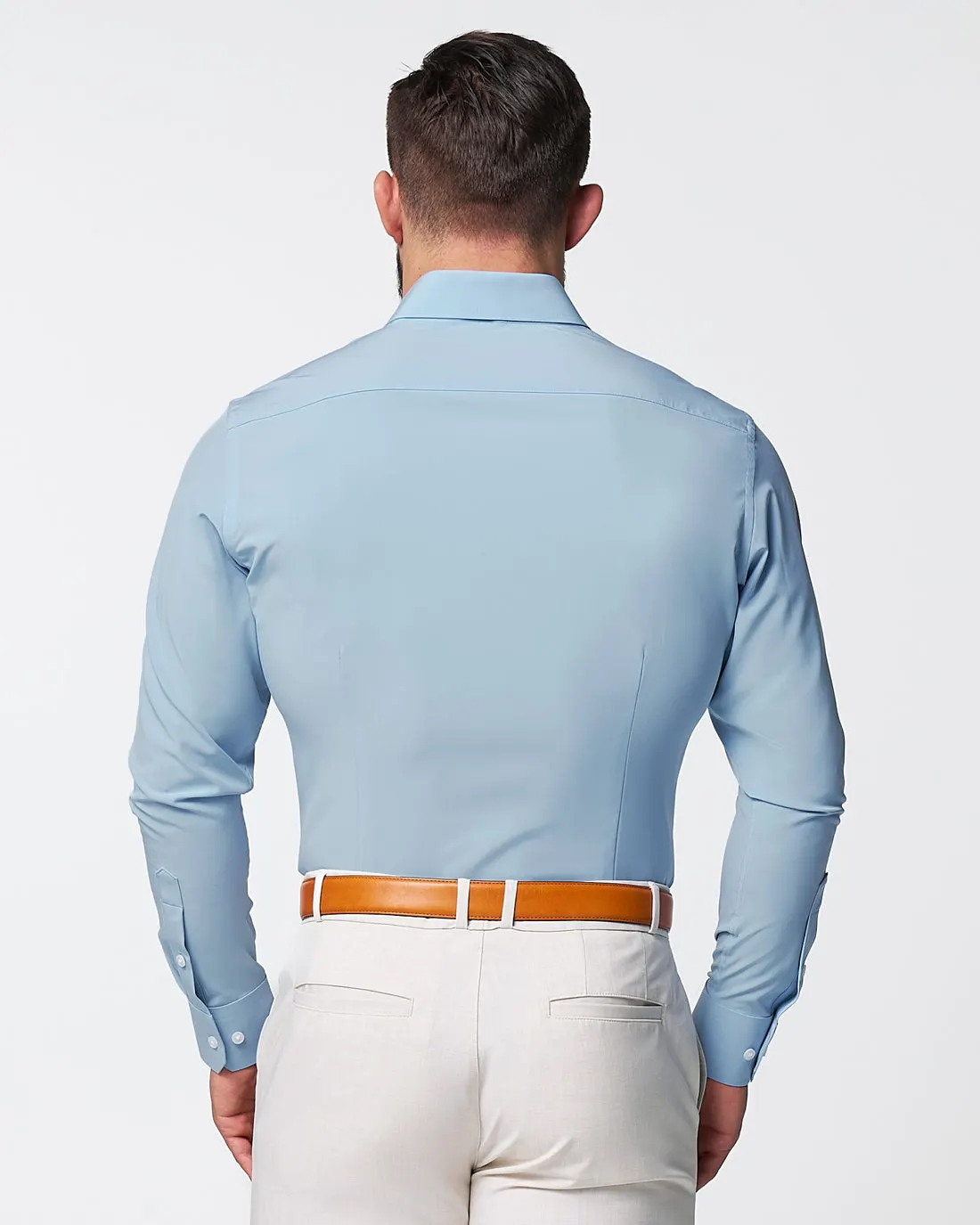
Their answer has three parts, all of them stated on the brand’s own product page. More room through the chest, shoulders and biceps. A waist cut close rather than straight. And darts in the back that pull the excess fabric in, which is the same operation a tailor performs on a finished shirt, except it happens on the pattern before the shirt exists.
The chart shows exactly how much room that assumes. Take the midpoint of the chest range and the midpoint of the waist range at each size, and the design holds the two apart by six to eight inches all the way up the run.
Six to eight inches is a lot of shape to build into a flat piece of cloth. It is also, in one number, the reason a standard shirt in your chest size looks like a sail from behind: it was drafted for a much smaller gap, and the fabric it does not need has to go somewhere.
Part fourA tapered pattern only works if the cloth gives
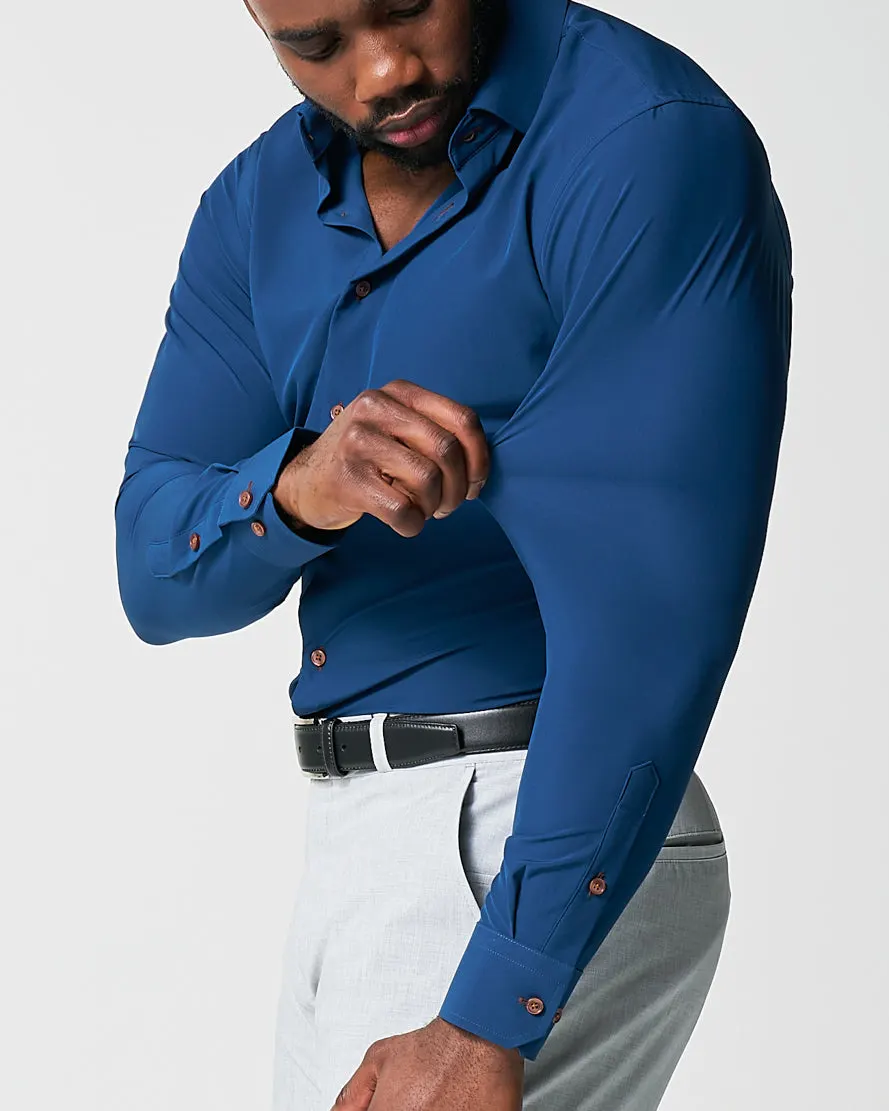
Cut a woven cotton shirt this close through the chest and back and you get the other classic failure: it fits perfectly while you stand still and binds the moment you reach across a table. State & Liberty’s shirts are not woven cotton. The house fabric, which the brand calls Pro Performance, is 92 percent polyester and 8 percent spandex, described on its fabrics page as lightweight, breathable, four way stretch, moisture wicking, wrinkle free and machine washable.
The company puts it less politely on its own product page. The days of ripping through your elbows and back seam are over. They stole the properties of your favorite workout shirt, they write, and built a professional looking dress shirt out of them.
That is the part most men notice second and end up caring about first. A close cut in a rigid fabric is a costume you take off at six. A close cut in a fabric with four way stretch is just a shirt.
Part fiveWhat 837 buyers wrote down before they wrote a review
There is an unusual amount of evidence available here, and it is worth being precise about where it comes from. State & Liberty’s dress shirts share a single public review group. At the time of writing it holds 837 published reviews with an average of 4.8. Before a customer writes anything, the review form asks him four questions: the size he bought, the size he normally wears, his height and his weight. The answers are published next to every review.
That makes the review wall something closer to a fitting log than a testimonial page. Counted as a set, on August 18, 2026, this is what it says.
The published review set, counted
That is a high number for a fit this specific, and the direction of the exceptions is the interesting part. Almost nobody sizes down. The men who move, move up, because the pattern spends its allowance on the chest and the back rather than on the middle.
The brand’s own instruction matches. On its product page it tells you, in three lines, to expect a V shaped cut with an extremely tapered waist, to order two sizes and send one back, and, if you are between sizes, to size up. Returns and exchanges within the United States are free, within 30 days, with return shipping paid, according to the published return policy.
The same review set also describes who is standing in front of the mirror. Of the 440 men who gave a weight, 228 were 190 pounds or more. Of the 448 who gave a height, 208 were six feet or taller.
The same sentence, over and over
Read enough of those reviews and one structure repeats until it stops being a coincidence. A man describes a body, then describes a compromise he has been making, then says the compromise is no longer necessary. The measurements below each quote are the ones the reviewer entered himself.
Finally found shirts that fit me. Most shirts I have that fit my upper body are way too big around the waist.
Jay M. · 6 ft 2, 190 to 210 lb · bought XL, normally wears XLMy job requires I wear a suit daily. I have broader shoulders than average shirts fit for so always have to go a size up and then fold the shirt in the back unless I want to spend a ton on tailored and dry cleaning. These fit great and don’t need dry cleaning.
Anthony B. · 5 ft 11, 170 to 190 lb · bought large, normally wears mediumFinally a shirt made for athletic builds. I normally wear an XL or 2XL and they are always so baggy around the stomach, made for big belly guys. I bought this shirt first, loved it so much ordered another six ...
John A. · 6 ft 0, 210 to 230 lb · bought XL, normally wears XLFor reference, I got a 2xl. I have a muscular build with broad shoulders and small waist. 6’ 230 lbs, waist 30 in. ... I’m always worried there will be too much extra fabric when I tuck shirts in. My Tailor even said it doesn’t need any alterations.
Evan K. · 6 ft 0 · bought 2XL, normally wears 2XLIf off the rack shirts don’t fit, S&L is the place to shop. Broad through the shoulders and chest and very tapered down through the waist.
Christian m. · 6 ft 3, 190 to 210 lb · bought XL, normally wears XLI had a tailor dress shirt before this but the fabric was stiff and did not allow for room in the shoulders and arms. This shirt is perfect for guys who are constantly battling stiff shirts and want a stretch tailored fit that feels great to wear.
Tyler N. · 5 ft 10, 190 to 210 lb · bought large, normally wears largeAll six are published on stateandliberty.com, with the reviewer’s own height, weight and sizing entered at the time of writing.
Part sevenWhere the pattern works against you
A shape this specific excludes people, and the same review wall says so plainly. It is worth reading the dissent, because it is the fastest way to know whether any of this applies to you.
I bought a XXL thinking it would be a tent like every other shirt, but maybe a comfy stretchy. I would say it fits more like a traditional large or medium shirt. ... It’s a shame because they are great quality and materials, they just aren’t made for people like me.
Joshua W., 5 ft 10, 230 to 250 lb, four stars. He gives his own measurements in the review: 50 to 52 inch chest, 48 inches around the midsection.
Look at those two numbers against the chart. A chest of 50 to 52 inches with a 48 inch waist is a gap of two to four inches, and the pattern is drafted for six to eight. Another reviewer, William B., reaches the same conclusion in one line: the shoulders and chest were right, and he would have needed four more inches through the middle.
That is not a manufacturing defect. It is what happens when a pattern commits to a shape instead of splitting the difference. If your waist is close to your chest, this shirt will fight you, and no size will fix it, because the taper is drawn in rather than added on.
- Does the collar only close on a shirt that is loose everywhere else?That is the neck and the chest disagreeing, and it is the exact gap the chart above shows.
- When you tuck in, is there fabric to gather at the back before you can close your belt?A reviewer quoted above describes folding it in the back by hand. It is the excess a drafted taper removes.
- Do you buy for the shoulders and then pay someone to take in the waist?State & Liberty says its founders did this for years before starting the company.
- Measure your chest under the arms, then your waist. Is the first at least six inches larger?Six to eight inches is the gap this pattern is drawn for. Under three or four, it is the wrong shirt.
Three or four yes answers and the chart at the top of this page was drawn for your torso. One or none, and you are better served by a standard fit, which is not an insult, it is just a different shape.
Part eightThe rest of it, briefly
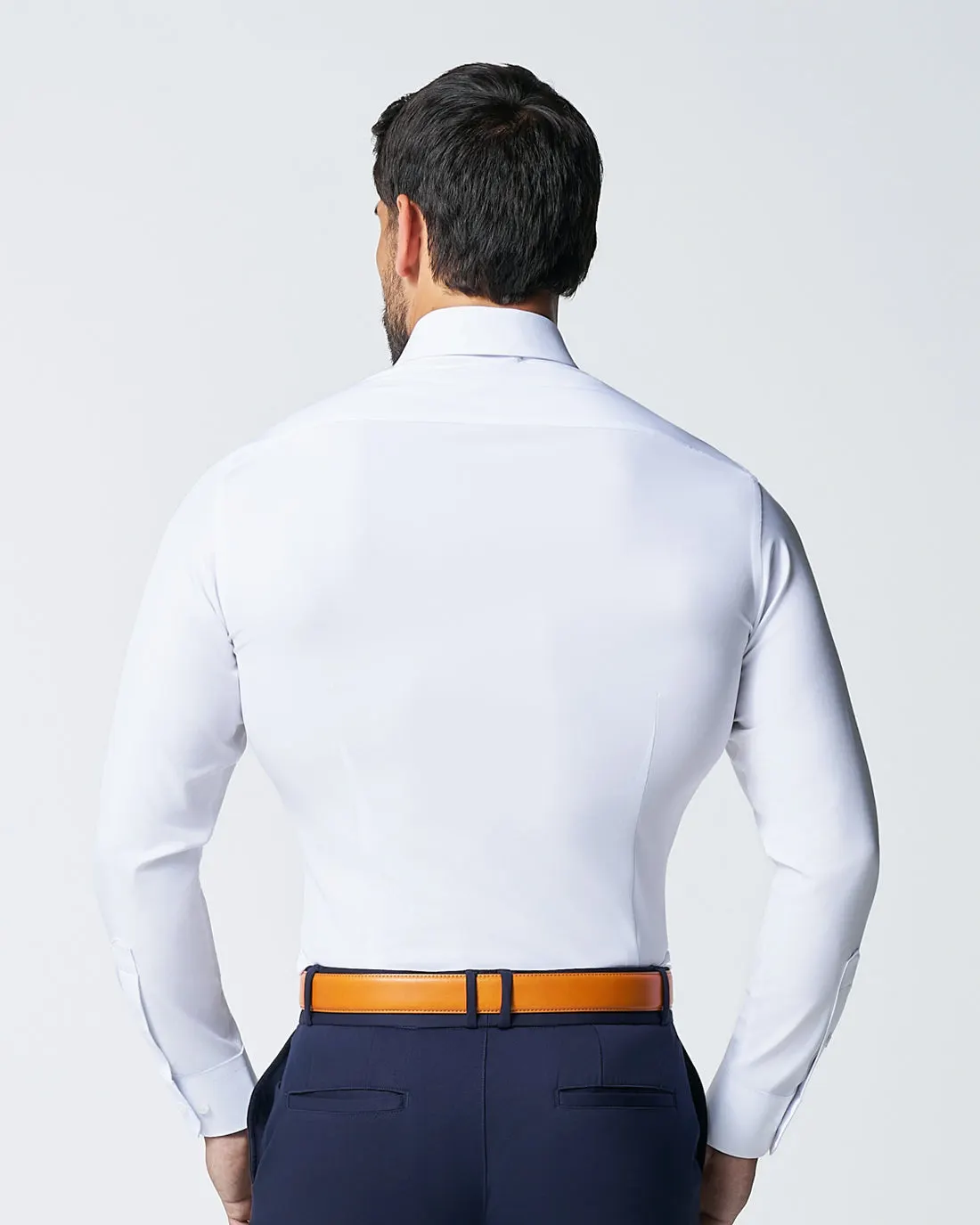
| Price | $105 for the Pro Performance dress shirts shown here, as listed on the brand’s dress shirt collection. |
|---|---|
| Fabric | 92 percent polyester, 8 percent spandex. Four way stretch, moisture wicking, wrinkle free, machine washable. |
| Collar | A hidden button under the collar holds it standing when no tie is worn. Unfasten it and it reverts to a standard semi spread collar. |
| Care | Cold wash, hang to dry. No dry cleaning. State & Liberty puts the average man’s dry cleaning bill at more than $500 a year. |
| Sizing | Seven sizes, extra small to triple extra large. The brand recommends ordering two sizes and returning one, and sizing up if you are between. |
| Returns | 30 days, unworn and tagged, return shipping paid inside the United States, refund or exchange. |
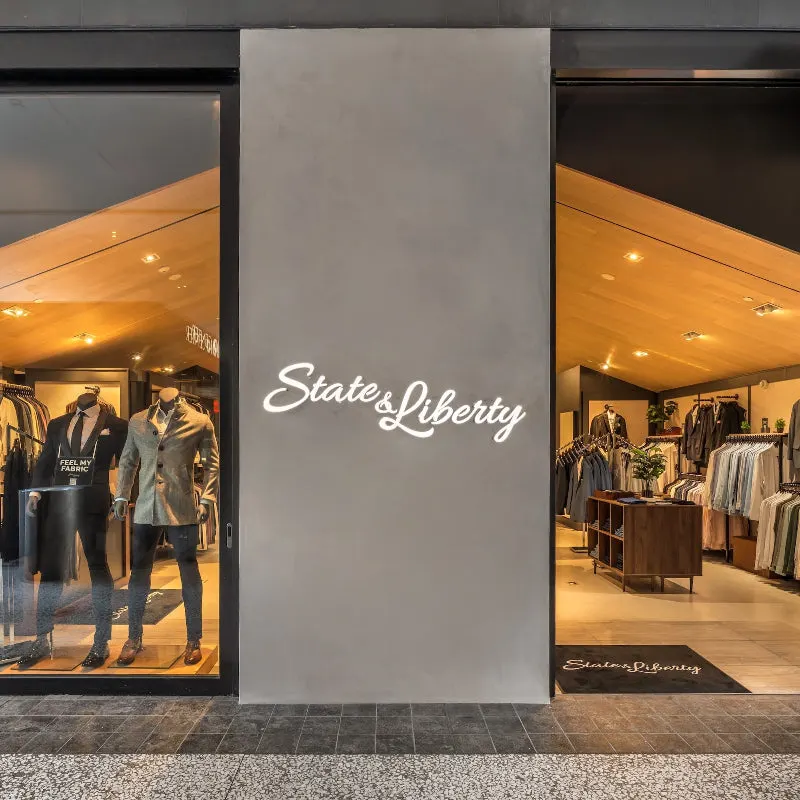
| In person | More than forty stores, plus a virtual sizing consultation and a made to measure option for bodies the chart does not reach. |
The hidden collar button is the detail reviewers keep returning to, which is telling for a feature nobody shops for. One review calls it the best part of the shirt and expects it to survive the wash. Another puts it more memorably: the collar is reinforced and stays standing, so the floppy collar is gone.
Where to start
If the chart at the top described your torso, the shortest useful path is not a style decision, it is a measurement. Chest first, then waist, then read the chart in that order and ignore your collar size entirely for one purchase.
Then pick the plain one. Almost every review quoted here is about a solid white, a solid navy, a business blue or a solid black, because that is where a fit like this is either right or obviously wrong, with no pattern to hide behind.
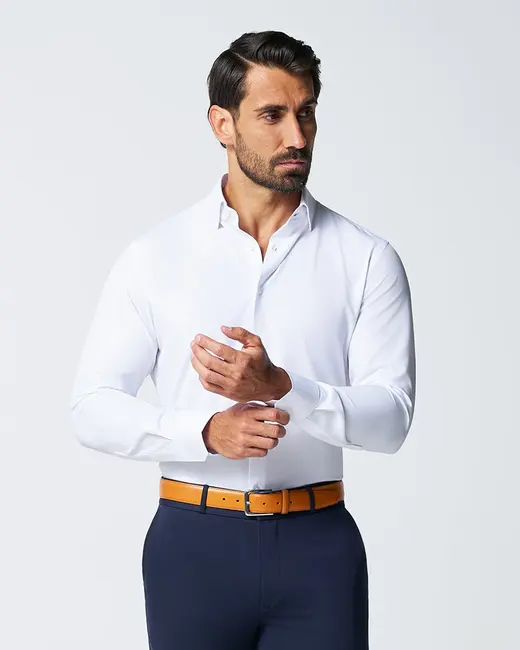 “The Springer” Solid White$105
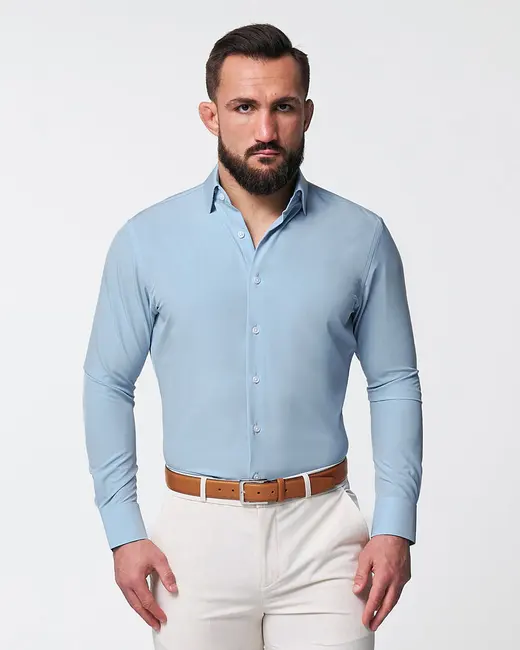 “The Bellamy” Business Blue$105
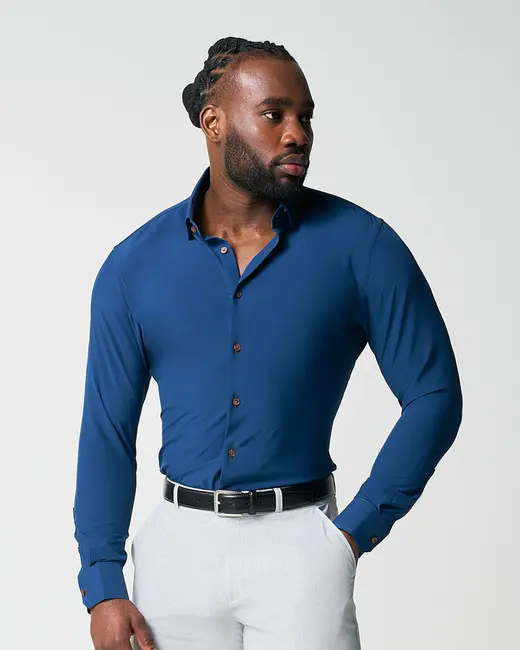 “The Howard” Solid Navy$105
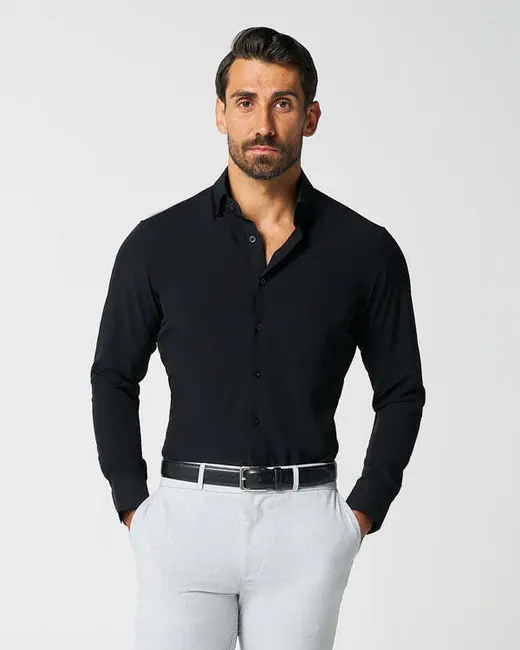 “The Von” Solid Black$105
Prices, measurements and policies above were read on stateandliberty.com on August 18, 2026.
Either way, the instruction that matters is the small one. Lead with the chest. The collar was never the number that decided anything.